
Laddering After a Loss vs. Random Betting in Craps: What Actually Counts as Strategy?
If you spend any time around a craps table—or watching craps content online—you’ll hear players talk about their “strategy.” Often, that strategy involves laddering bets after a loss: increasing the next wager to try to recover what just happened.
It sounds disciplined. It feels intentional. It looks structured.
But here’s the uncomfortable truth:
Laddering after a loss is not meaningfully different from randomly picking a bet—except for the story the player tells himself.
Let’s break down why.
What Is Laddering in Craps?
Laddering is when a player increases their bet size after a loss.
Examples:
- Lose $25 → bet $50
- Lose $50 → bet $100
- Lose $100 → bet $200
The belief—spoken or unspoken—is:
“Because I just lost, I should now bet more to recover.”
This feels logical. It feels like action. It feels like control.
But in craps, this reasoning has a fatal flaw.
The Independence of the Dice
Every roll of the dice in craps is independent.
- The dice have no memory.
- The table does not “owe” you a win.
- The probability of rolling a 7, 5, 8, or any number does not improve because you just lost.
So if your next bet size is based on the fact that you just lost, then your decision is not based on math or probability.
It’s based on emotion.
“Finger in the Wind” — Betting the 5 at Random
Now imagine a different player. He shrugs and says:
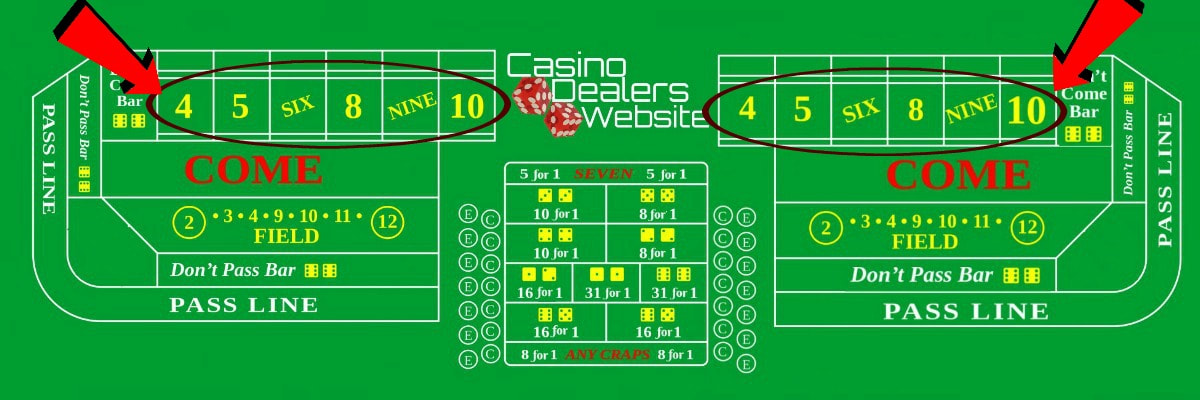
“I’ll just bet the 5.”
No story. No recovery plan. No system. No claim that the last roll matters.
He simply places a bet with known odds and a known house edge.
Oddly enough, this player is being more intellectually honest than the laddering player.
Why?
Because he is not pretending the past gave him insight into the future.
The Key Comparison
| Factor | Laddering After a Loss | Random Bet on the 5 |
|---|---|---|
| Uses the past roll to decide the next bet | Yes | No |
| Claims hidden logic | Yes | No |
| Changes the probability of the next roll | No | No |
| Improves expected value (EV) | No | No |
| Increases risk and variance | Yes | Neutral |
| Provides psychological comfort | High | Low |
Mathematically, both players are at the mercy of the same house edge.
But the laddering player is taking on more risk while believing he is being strategic.
Why Laddering Feels Like Strategy
Laddering has structure:
- A plan
- A sequence
- A recovery path
Humans associate structure with intelligence. We assume that if something looks organized, it must be logical.
But in craps, a strategy must be based on one of four things:
- Changes in probability
- Changes in table conditions
- Payout differences
- Exposure control relative to bankroll
Laddering is based on none of these.
It is based on the discomfort of losing.
What Real Craps Strategy Looks Like
A true craps strategy does not change because you lost.
It changes only when:
- The point changes
- Numbers become working or not working
- Your exposure across the layout changes
- The math of the situation changes
In other words:
A real strategy reacts to the table, not to your emotions.
The Brutal Truth Most Players Avoid
If the only reason you are increasing your bet is because the last one lost, then:
You are not playing a strategy. You are managing grief.
And the casino loves grief management systems, because they:
- Increase bet size
- Increase volatility
- Accelerate bankroll loss
- Feel smart while doing it
Final Thought
There is nothing wrong with betting randomly on the 5. At least it’s honest.
What’s dangerous is believing that laddering after a loss is some form of disciplined, intelligent play—when mathematically, it has no more foundation than sticking your finger in the wind and picking a number.
In craps, probability is the only guide you have.
And probability does not care that you just lost.
Gus Santos